7 min read
King George III delivered his verdict on the American Revolution in a letter to Lord North on November 18, 1774: “blows must decide whether they are to be subject to this country or independent.” Every quote below is verified against the king’s letters, speeches, and papers in the Royal Archives — and three famous fakes are flagged at the end.
| Quote | Where he said it | Date |
|---|---|---|
| ”The die is now cast…” | Letter to Lord North | Sept 11, 1774 |
| ”Blows must decide…” | Letter to Lord North | Nov 18, 1774 |
| ”The rebellious War now levied…” | Speech opening Parliament | Oct 26, 1775 |
| ”Knavery… the striking feature…” | Letter to Lord Shelburne | Nov 10, 1782 |
| ”Resolved to resign My Crown…” | Unsent abdication draft | March 1783 |
| ”America is lost!” | Essay in Royal Archives | Mid-1780s |
| ”First to meet the friendship…” | Audience with John Adams | June 1, 1785 |
THE AMERICAN REVOLUTION
“The dye is now cast, the Colonies must either submit or triumph; I do not wish to come to severer measures but we must not retreat; by coolness and an unremitted pursuit of the measures that have been adopted I trust they will come to submit.”
George III wrote this to his prime minister, Lord North, on September 11, 1774, as the First Continental Congress gathered in Philadelphia — “dye” is the king’s own spelling, preserved in his correspondence. It also preserves his theory of the war: stay cool, keep squeezing, and the colonies would fold.
“The New England governments are in a state of rebellion, blows must decide whether they are to be subject to this country or independent.”
To Lord North again, November 18, 1774, in the same correspondence, after news of the Continental Congress reached London. Parliament took the hint and declared Massachusetts in rebellion in February 1775 — two months before Lexington.
“The rebellious War now levied is become more general, and is manifestly carried on for the Purpose of establishing an independent Empire. I need not dwell upon the fatal Effects of the Success of such a Plan.”
From the king’s speech opening Parliament on October 26, 1775, declaring the colonies in open rebellion. George III accused the Americans of fighting to establish “an independent Empire” nine months before they got around to declaring one.
“I cannot conclude without mentioning how sensibly I feel the dismemberment of America from the Empire, and that I should be miserable indeed if I did not feel that no blame on that account can be laid to my door, and did I not also know that knavery seems to be so much the striking feature of the inhabitants, that it may not in the end be an evil that they will become aliens to this Kingdom.”
George III to Prime Minister Lord Shelburne, November 10, 1782, as British negotiators in Paris conceded American independence. Note the order of operations: no blame at his own door first, sour grapes second.
“A long Experience and a serious attention to the Strange Events that have successively arisen, has gradually prepared My mind to expect the time when I should be no longer of Utility to this Empire; that Hour is now come; I am therefore resolved to resign My Crown and all the Dominions appertaining to it to the Prince of Wales.”
From an abdication message George III drafted in March 1783 but never delivered, during the political crisis that followed the lost war. He planned to retire to Hanover. The draft sat unseen in the Royal Archives until 2017.
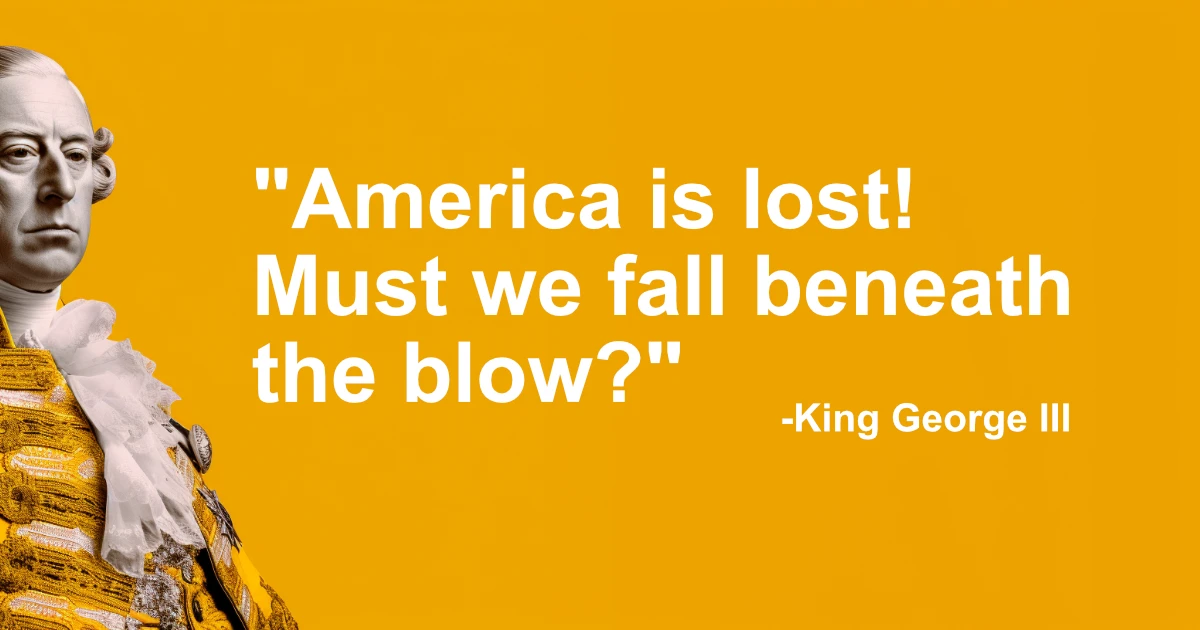
“America is lost! Must we fall beneath the blow? Or have we resources that may repair the mischiefs?”
The opening of an undated essay from the mid-1780s, preserved at Windsor in the king’s own hand. One caveat the quote sites skip: Royal Archives researchers found that he copied much of the essay from the agricultural writer Arthur Young — these are words George III chose to write out, not necessarily words he coined.
“I was the last to consent to the Separation: but the Separation having been made, and having become inevitable, I have always Said as I say now, that I would be the first to meet the Friendship of the United States as an independent Power.”
Spoken to John Adams at his presentation as the first American minister to Britain, June 1, 1785. Adams wrote the exchange down the next day for John Jay — adding, honestly, “I dare not Say, that these Were the Kings precise Words.” Both men, he reported, were visibly moved.
REIGN & CHARACTER
“Born and educated in this Country, I glory in the Name of Briton.”
George III’s first speech to Parliament as king, November 18, 1760. “Briton” is how the 1760 broadside prints it, though historians often modernize it to “Britain.” The line mattered: after two German-born Georges, here was a Hanoverian king raised in England, and he wanted Parliament to hear it.
“But was there ever such stuff as great part of Shakspeare? Only one must not say so! But what think you? What? Is there not sad stuff? What? What?”
The king to the novelist Fanny Burney at Windsor, December 19, 1785, as her diary records it — verbal tics and all, and “Shakspeare” is her spelling. He immediately caught himself: “one should be stoned for saying so.”
QUOTES KING GEORGE III NEVER SAID
The internet’s favorite George III quotes are the ones with no paper trail. Three that deserve retirement:
“I have not yet begun to fight!”
That defiance belongs to John Paul Jones, shouted — perhaps — from the sinking Bonhomme Richard as it grappled HMS Serapis on September 23, 1779. Even for Jones the wording is shaky: it first appeared in print in 1825, recalled by his lieutenant Richard Dale 46 years after the battle. George III’s only connection is that Jones was fighting his navy.
“Nothing important happened today.”
Supposedly the king’s diary entry for July 4, 1776. George III kept no diary, as the British Library’s manuscript curators have pointed out. The story is borrowed: Louis XVI wrote “rien” in his hunting journal on July 14, 1789 — the day the Bastille fell — and the anecdote migrated across the Channel.
“I wish nothing but good; therefore, everyone who does not agree with me is a traitor and a scoundrel.”
The most-quoted “George III quote” online has no primary source. It is the novelist William Makepeace Thackeray’s caricature of the king’s attitude, from his 1862 lecture series The Four Georges. A century of quote books promoted Thackeray’s joke into the king’s own mouth.
For the American side of the war of words, see these American Revolution quotes.
KING GEORGE III QUOTES FAQ
What is King George III’s most famous quote?
His most famous line is “America is lost! Must we fall beneath the blow?” — the opening of a 1780s essay in his own hand, now in the Royal Archives. His most consequential words were plainer: “blows must decide,” written to Lord North in November 1774, five months before Lexington.
What did King George III say to John Adams?
Receiving Adams as the first American minister on June 1, 1785, the king said he had been “the last to consent to the separation” but would be “the first to meet the friendship of the United States as an independent power.” Adams recorded it the next day, admitting he could not vouch for the precise words.
What is King George III most famous for?
George III is remembered for losing the American colonies, for the recurring mental illness — attributed by modern scholars to porphyria or bipolar disorder — that forced the Regency of 1811, and for reigning 59 years, longer than any British king before or since. Only Queens Victoria and Elizabeth II have reigned longer.
The king’s words are only half the story — test your grip on the other half with our American Revolution quiz, where one question turns on what George III reportedly said when told Washington would give up command and go home to his farm.