8 min read
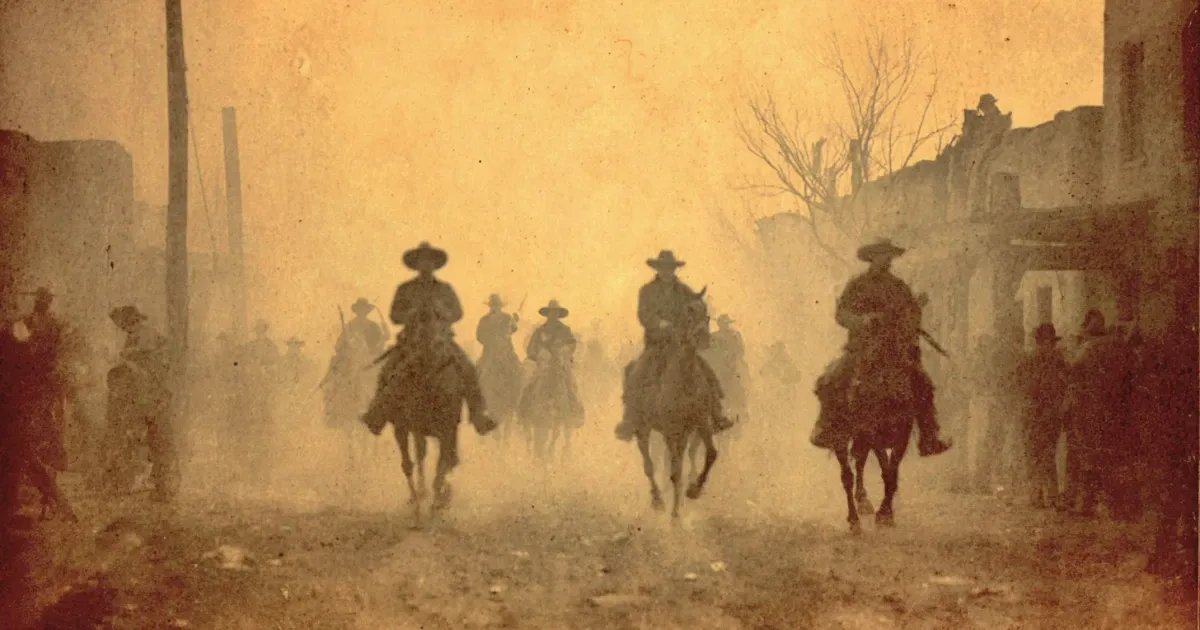
The sun beat down on the assembled regiments as they awaited orders along the dusty Texas-Mexico border.
Nervous energy charged the air—this was it, the moment they had trained for. After Pancho Villa’s brazen attack on Columbus, these American soldiers were tasked with bringing the notorious bandit to justice.
They would be the orderlies commanded to conduct a massive manhunt into Mexico’s unforgiving wilderness.
In their ranks stood a young Lieutenant named John Russell.
He stared south at the Rio Grande that seemed so narrow now with the weight of adventure pressing down. Somewhere beyond that muddy boundary lay Villa and his rebel fighters, roaming free in the rugged vastness.
Russell had heard the tall tales about Villa—how he could melt into the desert like a ghost, raiding at will before disappearing without a trace.
They called him the Centaur of the North, legend already placing Villa in the pantheon of Western folk heroes like Billy the Kid.
But in Columbus, the romantic legends had turned darkly real. Villa’s rebellion had crossed the border to leave American blood spilled on American soil.
Russell was glad now for the Colt .45 pistol heavy on his hip and Springfield rifle slung across his back. He would need them where they were going.
“Mount up!” shouted the grizzled Sergeant Jones.
This was it.
As his boots hit the stirrups, Lieutenant Russell said a silent prayer that God might keep watch over the mission ahead. Adventure and justice awaited south of the border, but so did Villa’s merciless band of guerrilleros.
As Pershing led the way into Mexico, Russell knew there would be glory and peril ahead.
The Punitive Expedition was about to get real.
THE COLUMBUS RAID

In the early morning hours of March 9, 1916, the notorious Mexican revolutionary leader Pancho Villa led several hundred men in an assault on the small border town of Columbus, New Mexico.
Seeking supplies and weapons, Villa’s force attacked a detachment of the 13th Cavalry Regiment, looting and burning parts of the town.
18 Americans were killed in the raid.
News of the Columbus raid sparked outrage across the United States.
Calls for swift retribution against Villa came from all quarters. Seeking to reassert American might and deter further border incursions, President Wilson dispatched nearly 5,000 troops under General John J. Pershing into Mexico just days later.
This Punitive Expedition, sometimes known as the Pancho Villa Expedition, was a military operation fueled by a desire for retribution against Villa in the aftermath of Columbus. Pershing’s troops sought to capture or kill the rebel leader who had dared to spill American blood.
PERSHING’S EXPEDITIONARY FORCE

The Punitive Expedition into Mexico in 1916 was the largest U.S. Army operation on foreign soil since the Philippine–American War.
President Wilson tasked General John J. Pershing with leading the punitive force to hunt down Pancho Villa in retaliation for his attack on Columbus, New Mexico.
Pershing’s expeditionary army eventually grew to more than 10,000 men, composed of cavalry, infantry, logistical support trains, and early aircraft.
The logistics of supplying and mobilizing such a large military force over rugged terrain and across the international border presented new challenges for the U.S. Army.
The Punitive Expedition provided valuable experience in projecting American military power beyond North America.
The Punitive Expedition marked one of the first times America flexed its muscles as an emerging global military power.
PANCHO VILLA EVADES PERSHING IN THE SIERRA MADRES

Although General Pershing led over 10,000 troops deep into Mexico’s rugged northern states, the Punitive Expedition failed in its primary objective to capture or kill Pancho Villa.
Pershing divided his forces into several columns to converge on Villa’s location, but the wily rebel leader adeptly evaded the massive manhunt in the remote Sierra Madre mountain range.
Villa relied on his familiarity with the arid, mountainous terrain and strong rapport with the local villagers to always stay one step ahead of his American pursuers.
Pershing grew increasingly frustrated as Villa continued to elude his large military force, staging deadly ambushes on Pershing’s troops before vanishing back into the Sierra Madres.
Despite utilizing cavalry, trucks, aircraft, and Apache scouts, the expedition could not pin down Villa.
Villa emerged from his mountain hideouts uncaptured and undeterred, persistently fighting the Mexican government until 1920. The Sierra Madres provided refuge to Pancho Villa, allowing him to embarrass Pershing’s Punitive Expedition.
BRINK OF WAR

As Pershing’s troops plunged deep into Mexican territory searching for Pancho Villa, they collided with Mexican government forces on several occasions.
In the town of Parral, more than 500 miles inside Mexico, on April 12, 1916, an angry confrontation led to Mexican soldiers and townspeople opening fire on U.S. cavalry, killing two American soldiers. Both governments anxiously worked to defuse the situation before it sparked a full-blown war.
Tensions boiled over in June at the Battle of Carrizal, when U.S. cavalry clashed with Mexican government troops and lost 12 men killed and 24 captured.
Outrage swept Mexico as the two nations were brought alarmingly close to direct war.
Though both governments took steps to quell the calls for military mobilization, the armed clashes polarized public attitudes along the border.
The Punitive Expedition’s repeated run-ins with Mexican troops inflamed the tinderbox of the U.S.-Mexico relations, threatening to ignite a powder keg of all-out war between two sovereign nations with simmering grievances.
The ill-fated manhunt for Villa pushed the limits of restraint along the troubled border.
THE RISE OF AMERICAN AIR POWER

The Punitive Expedition provided the first major test of utilizing aircraft for military operations in American history.
Pershing brought the 1st Aero Squadron’s eight Curtiss JN-3 “Jenny” biplanes into the expedition for reconnaissance and courier missions in Mexico’s vast wilderness.
The underpowered Jennies struggled over the high mountains, and within weeks only two were still flyable.
Even so, the pilots who kept them flying carried dispatches and scouted ahead for the cavalry columns.
The Army’s Signal Corps managed the burgeoning aviation effort, the ancestor of the service that would become the U.S. Air Force in 1947, gaining critical experience with tactical air operations.
The Punitive Expedition offered early lessons in coordinating air power with ground forces.
Despite not capturing Villa, the expedition demonstrated to military planners the viability of aircraft in future wars. The Jenny biplanes ushered in a new era for American air capabilities.
APACHE SCOUTS AT OJOS AZULES

General Pershing utilized Apache scouts extensively during the Punitive Expedition for their unmatched tracking skills and knowledge of the harsh Mexican wilderness.
These indigenous scouts served as the expedition’s eyes and ears, able to interpret subtle signs of Villa’s passing that other soldiers missed.
On May 5, 1916, Apache scouts under Lieutenant James A. Shannon helped lead a dawn cavalry attack on a Villista camp at Ojos Azules, one of the few clear American victories of the campaign.
THE CARRIZAL DISASTER

On June 21, 1916, Captain Charles T. Boyd led two troops of the 10th Cavalry toward the town of Carrizal in northern Chihuahua to scout Mexican government positions.
There he found federal troops under General Félix Gómez, who had orders to stop any American move except northward. Boyd was warned not to pass and attacked anyway.
The Mexicans held. Boyd and 11 of his men were killed and 24 were captured, while Gómez also died in the fight.
The Carrizal clash sparked outrage in both nations.
Mexico condemned the attack on its soldiers, while Americans decried their troops being captured. Calls for war grew loud on both sides of the Rio Grande.
The prisoners were soon released, and both governments stepped back. But Boyd’s decision to force his way through nearly provoked a full-scale conflict that neither nation truly wanted.
THE PUNITIVE EXPEDITION’S END

After nearly a year of fruitless pursuit in Mexico, the Punitive Expedition was drawn to an inconclusive close in January 1917.
Pershing was ordered out in January 1917, and the last troops crossed back by February 5, two months before the United States entered the First World War. Attention and resources needed to shift to the far more pressing European conflict.
Despite the massive manhunt, Pancho Villa emerged in 1917 just as he began—uncaptured and defiant. The failure to apprehend or kill Villa allowed him to continue his ongoing rebellion against the Mexican government even after Pershing withdrew.
The expedition’s end did little to stop Villa, who persevered in guerrilla actions against Mexican federal forces until 1920.
He skillfully extended his uprising despite the might of the American military being leveraged against him for a time. Villa would outlast the Pershing expedition, remaining at large until he negotiated amnesty in 1920, the same year the Zapatistas under Gildardo Magaña joined the federal army.
The inconclusive withdrawal of American forces cleared the way for Villa’s ongoing rebellion. Pershing failed to finish the job in Mexico.